As we navigate into Spring of 2026, we find ourselves living in a culture defined by a strange and heavy paradox. We are more connected than any generation in human history, yet we are arguably the most isolated. We have more tools for “wellness” at our fingertips than ever before, yet the rates of clinical anxiety and deep-seated depression have surged to record-breaking heights. For the Christian woman, this cultural weight is often compounded by a heavy, suffocating layer of spiritual shame that the secular world does not carry. You sit in the sanctuary on Sunday morning, or perhaps you stand in your kitchen on a Tuesday afternoon, heart racing and breath shortening, while a persistent whisper in your mind tells you that if your faith were only stronger, this shadow would vanish.
We have too often been told, either explicitly from a pulpit or implicitly through Christian social media, that anxiety is a choice—or worse, a sign of a backslidden heart. Many women feel like spiritual failures because they cannot “simply pray away” a panic attack. They treat their mental health as a cold barometer for their salvation, erroneously believing that a chemical imbalance or a response to profound life trauma is actually a sign of spiritual deficiency. We must start by dismantling the lie that a struggle with anxiety is a disqualification from the grace of God. To do that, we must first look at the reality of the world we are living in.
The Landscape of 2026: A World Under Pressure
If you feel like the world is louder and heavier than it used to be, you are not imagining it. The biological systems God gave us to protect us—our “fight or flight” responses—are being triggered at a frequency that the human frame was never designed to endure. From the constant influx of global crisis data to the rising cost of simply existing, the “why” behind our collective anxiety is rooted in a very real, very modern pressure cooker.
Before we look at the theological bridge, let us validate the reality of your experience. You are not alone in this struggle. The following data shows the trajectory of the world we are currently ministering in:
Anxiety Prevalence in Women (2016–2026)
| Year | Percentage of Women Reporting Anxiety Symptoms | Primary Cultural/Environmental Stressors |
| 2016 | 18% | Economic recovery, early social media saturation. |
| 2019 | 23% | Increased digital “always-on” work culture, political polarization. |
| 2022 | 31% | Post-pandemic adjustment, inflation, and family health concerns. |
| 2024 | 34% | Escalating global conflicts and “information fatigue” from 24/7 news. |
| 2026 | 39% | Artificial Intelligence integration fears, social isolation, and record-high cost of living. |
Seeing these numbers should do one thing for you immediately: it should silence the voice that says you are the only one “failing” at peace. When nearly four out of ten women are navigating these waters, we must realize that we are facing a collective storm. But for the woman of God, the question remains: Is this feeling a sin?
The Theology of the Struggle
The reality of our biological and emotional design means that we live in fallen bodies within a fractured world. When we look at the Word of God, we see that the peace of Christ was never intended to be a magic wand that eliminates our humanity, but rather a bridge that sustains us through it. We must distinguish between the “spirit of fear,” which is a demonic oppression designed to keep us from our calling, and the physiological response of a nervous system under extreme pressure.
Many women suffer in silence because they confuse temptation or a symptom with transgression. If your heart begins to race because of a traumatic memory or a sudden surge of adrenaline, that is a biological event. It is no more a sin than a sneeze or a fever. Sin requires the consent of the will; a panic attack is an involuntary hijacking of the body’s safety systems. To help you discern where your heart stands, consider the following comparison:
Discerning the Heart: Is it Sin or a Struggle?
| Category | Sin (Requires Repentance) | Struggle (Requires Support) |
| Origin | Willful disobedience or a conscious turning away from God’s known Word. | Biological imbalances, environmental stressors, or the lingering echoes of traumatic triggers. |
| Internal Feeling | Conviction: A sharp, Holy Spirit-led nudge that leads toward change and restoration. | Overwhelm: A heavy, involuntary sense of fear, “brain fog,” or physical panic. |
| God’s Response | Forgiveness: God meets the repentant heart with immediate washing and restoration. | Compassion: God meets the weary heart with comfort, presence, and sustained strength. |
| Action Step | Confession: Acknowledging the fault and turning back toward the light of Christ. | Stewardship: Caring for the body (temple), seeking wise counsel, and finding community. |
| The Result | Spiritual freedom and a clear conscience before the Father. | Emotional resilience and the peace that “guards” the mind through the storm. |
The shame ends when we realize that seeking help—whether through counseling, lifestyle changes, or medical intervention—is not an act of unbelief, but an act of stewardship over the temple God gave us. We are complicated beings made of dust and spirit. We cannot ignore the dust (our biology) and expect the spirit to do all the work, nor can we ignore the spirit and expect the dust to find ultimate meaning.
The Military Guard of Peace
When we feel the walls closing in, we often turn to the most famous “anxiety verse” in the Bible. However, because of the shame we carry, we often read it as a reprimand rather than a rescue.
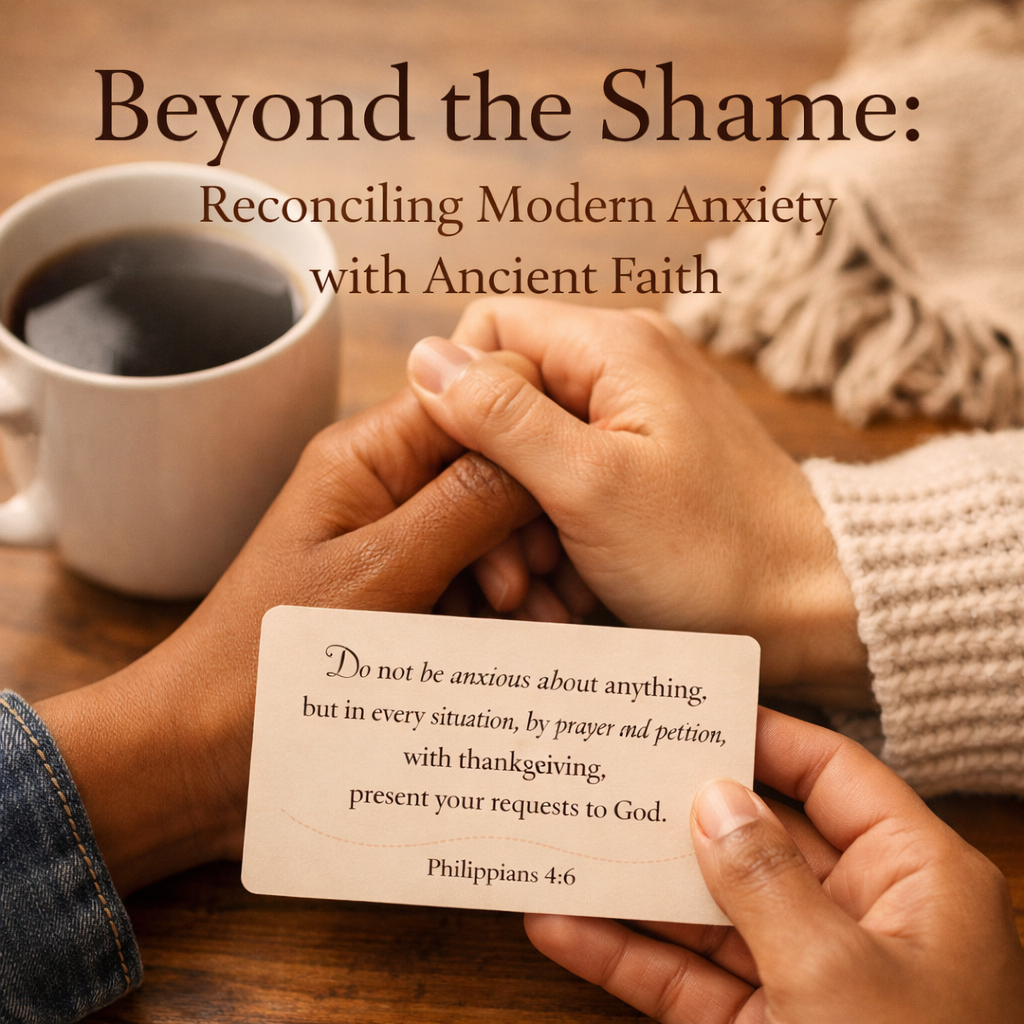
Be anxious for nothing, but in everything by prayer and supplication, with thanksgiving, let your requests be made known to God; and the peace of God, which surpasses all understanding, will guard your hearts and minds through Christ Jesus.
— Philippians 4:6-7 (NKJV)
In the original Greek, the word used for “guard” is phroureō. This is not a passive word; it is a military term. It refers to a garrison of soldiers standing at the gates of a city to prevent an enemy from entering. Paul is not telling you that the feeling of anxiety will never knock on your door. He is promising that as you bring the raw, unfiltered reality of your struggle to God, His peace stands as a sentry over your mind.
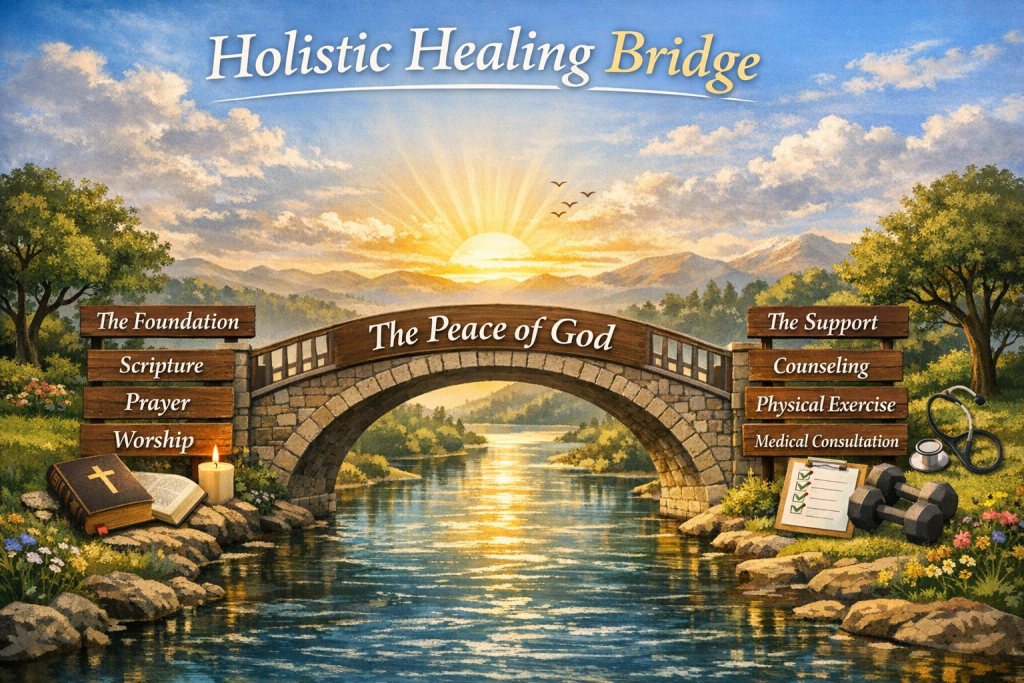
The “peace that surpasses all understanding” is exactly that—it is a peace that exists even when it doesn’t make sense for it to be there. It is the peace that allows a woman to breathe through a panic attack while she clings to the hem of His garment. It is a peace that co-exists with the struggle. Integration is the key. We must integrate the spiritual discipline of prayer with the practical reality of our physical needs.
If you had a broken leg, you would pray for healing while also going to the surgeon to have the bone set. You would not call the surgeon “an enemy of faith.” Mental health requires the same holistic approach. God is the author of the peace that surpasses understanding, but He is also the Creator of the doctors, the therapists, and the biological sciences that help us regulate our weary minds.
God’s Presence in the Multitude of Thoughts
One of the most beautiful aspects of our Shepherd is His willingness to enter the chaos with us. He does not wait for us to “calm down” before He draws near.
In the multitude of my anxieties within me, Your comforts delight my soul.
— Psalm 94:19 (NKJV)
The Psalmist provides us with a profound narrative truth: his anxieties were not gone. They were present, a “multitude” of them, swirling within his mind. And yet, within that very same space, God’s comforts were present. This is the bridge we must walk across. We can be women of profound, mountain-moving faith who also happen to be walking through a season of clinical depression or generalized anxiety. One does not negate the other. Your panic attack is not a sin; it is a signal that your system is overwhelmed.
When we bring that signal to the feet of Jesus, He meets us with compassion rather than a clipboard of requirements. He is the High Priest who is touched by the feeling of our infirmities. He remembers that we are dust. He knows the weight of the 2026 world, and He invites us to come boldly to the throne of grace to find mercy and grace to help in our time of need.
The Action of Casting
As a minister, I often see women try to “cast their cares” like they are throwing a heavy stone once and for all. But for those of us with biological anxiety, the cares often feel more like a boomerang.
Casting all your care upon Him, for He cares for you.
— 1 Peter 5:7 (NKJV)
To “cast” in this context is an active, ongoing motion. In the original language, it implies a decisive act of the will, but in our daily reality, it is a ritual we must repeat. It implies that the care may try to crawl back onto our shoulders, requiring us to cast it again and again.
For the woman struggling today, this might mean casting your cares through a morning devotion, and then again through a therapy session at noon, and perhaps once more through a prescribed medication or a grounding exercise at dinner. All of these tools are part of God’s provision for your thriving. He has provided a community of believers, a wealth of medical knowledge, and the indwelling of the Holy Spirit to help you navigate this.
Moving Beyond the Shame
If you are reading this and you feel the familiar tightness in your chest, I want you to take a deep breath. Right now. That breath is a gift from your Creator. Your value to the Kingdom of God is not diminished by your struggle with mental health. In fact, your struggle may be the very thing that allows you to minister to another woman who is drowning in the same sea of shame.
We serve a God who walked into the Garden of Gethsemane and experienced such intense emotional agony that His sweat became like great drops of blood. He understands the “multitude of anxieties.” He is not looking at you with disappointment because you need help; He is looking at you with love because you are His.
You are not a sin-laden failure. You are a courageous daughter of the King who is learning to navigate a difficult, high-pressure terrain with her Shepherd by her side. Reconciling your faith with your mental health is not a sign of weakness; it is a sign of a mature, integrated faith that recognizes God as the Lord over both the soul and the body.
The shame ends here. The healing—the holistic, messy, beautiful process of thriving in an anxious world—begins with the realization that you are loved in the midst of the storm, not just after it has passed.