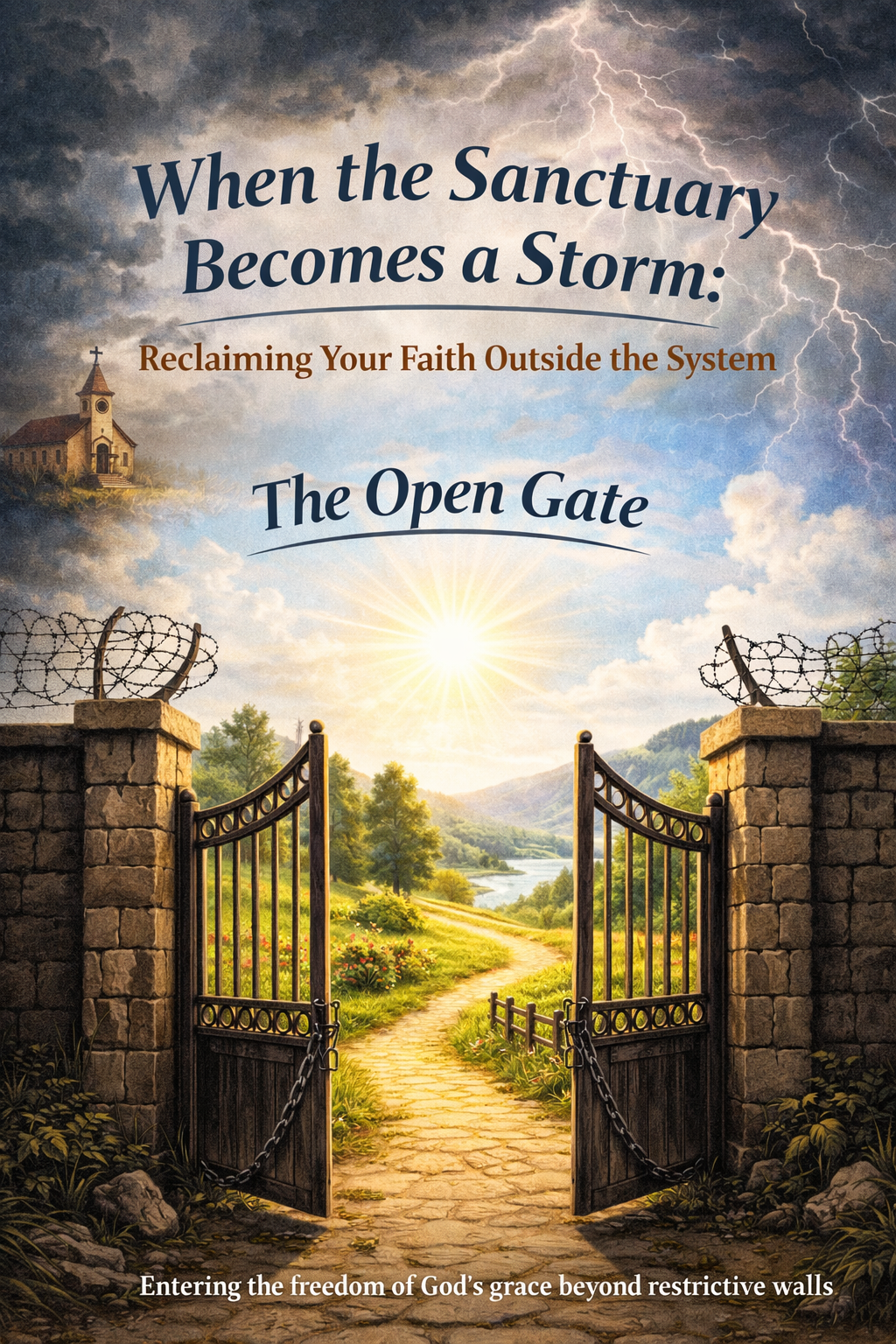
I have spent years walking alongside women in the ministry, I have watched the landscape of faith shift dramatically as we have moved into 2026. We are currently witnessing an unprecedented exodus, a quiet but powerful migration of women who are stepping away from the pews they once occupied with devotion. The data surrounding us is clear: women are exiting organized religion at rates we have never seen before, yet if you listen closely to their stories, you will find a profound distinction that the statistics often miss. These women are not necessarily leaving God, nor are they abandoning their Savior; rather, they are leaving the “system” of religion that has, in many cases, become a source of trauma instead of a source of life. They are weary of the institutional machinery that has often prioritized the preservation of a building or a reputation over the protection of the sheep. As a licensed minister, my heart breaks for the “church-hurt” woman because I know that for her, the sanctuary has become a storm, and the place that should have been a refuge has become a site of deep, spiritual scarring.
Understanding the 2026 Shift
To address this crisis, we must first look at the reality of why this is happening with such frequency in our current cultural moment. The following table provides a snapshot of the trends we are seeing in 2026 regarding women and their relationship with organized religion. It highlights the shift from “institutional loyalty” to “personal spiritual integrity.”
The 2026 Spiritual Landscape for Women
| Category | Traditional Institutional View | The 2026 “Safe Harbor” Perspective |
| Primary Loyalty | Loyalty to the denomination or local church body. | Loyalty to Jesus and personal spiritual health. |
| View of Authority | Unquestioned obedience to pastoral leadership. | Collaborative community with healthy boundaries. |
| Reason for Leaving | Labeled as “backsliding” or “losing faith.” | Recognized as “deconstruction” for the sake of survival. |
| Source of Community | Sunday morning service and church programs. | Small, intimate “Micro-communities” and digital harbors. |
| Affiliate/Resource Need | Church-branded curriculum and tithing. | Therapeutic resources, journals, and restorative retreats. |
Loving the Groom While Struggling with the Bride
The central tension for many women in 2026 is the agonizing conflict between their love for Jesus, the Groom, and their pain caused by the Church, the Bride. It is a unique kind of grief to feel deeply connected to the Creator while feeling utterly rejected or silenced by His representatives on earth. We must acknowledge that while the Church is theologically the Bride of Christ, she is currently a Bride in need of much grooming and repentance. In your journey, you may find that you are in a season where you cannot sit in a traditional service without your nervous system going into a state of high alert. This is not a sin; it is a physiological and spiritual response to trauma. The path back to peace begins when we realize that Jesus is not synonymous with the people who used His name to hurt us. He is the one who stands outside the camp with the marginalized, offering a hand to those who have been cast out by the very systems that claimed to speak for Him.
The Lord is near to those who have a broken heart, and saves such as have a contrite spirit.
— Psalm 34:18 (NKJV)
When we look at the life of Jesus, we see a Savior who was constantly at odds with the religious “system” of His day. He reserved His harshest words not for the broken or the “sinners,” but for the religious elite who tied up heavy burdens and laid them on men’s shoulders but would not move them with one of their fingers. If you feel like you are at odds with the “system,” you are in very good company. Jesus Himself was the ultimate outsider to the organized religion of the first century. He came to establish a Kingdom, not a bureaucracy. When you feel the weight of church hurt, remember that Jesus is the one who overturned the tables in the temple specifically because the “system” was hindering people from reaching God. He is more protective of your heart than He is of any religious institution’s reputation.
Come to Me, all you who labor and are heavy laden, and I will give you rest. Take My yoke upon you and learn from Me, for I am gentle and lowly in heart, and you will find rest for your souls.
— Matthew 11:28-29 (NKJV)
The Path Back to Peace
Healing from church hurt requires a deliberate and often slow process of separating the character of God from the character of the people who represented Him poorly. This site serves as a safe harbor for that very reason. We are not here to force you back into a pew; we are here to help you find the person of Jesus again in the quiet, safe spaces of your own life. Peace is not found in a return to the “system” that broke you, but in a return to the simplicity of the Gospel that heals you. This involves a process of “spiritual stewardship” where you decide what stays and what goes. You can keep the scriptures, the hymns, and the intimate relationship with the Holy Spirit while letting go of the toxic theology, the spiritual abuse, and the performance-based expectations that led to your burnout.
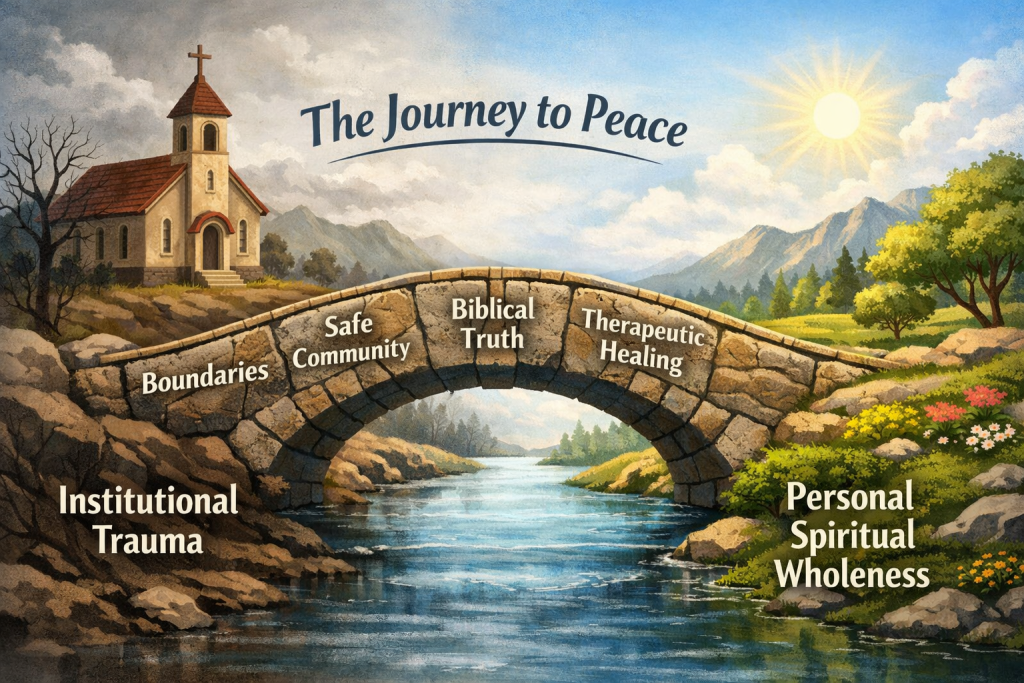
As you navigate this transition, it is essential to find what I call “Micro-communities.” These are small, safe pockets of believers—perhaps only two or three—who prioritize vulnerability over visibility. In 2026, the rise of the “Churchless Christian” woman is not a sign of a dying faith, but often a sign of a faith that is fighting for its life. You may find that your most profound worship happens in your living room with a few trusted friends rather than under the lights of a mega-church stage. This is a valid and biblical expression of the Body of Christ. The “Bride” is not a building; she is the people, and she is at her most beautiful when she is caring for the wounded among her.
But the hour is coming, and now is, when the true worshipers will worship the Father in spirit and truth; for the Father is seeking such to worship Him. God is Spirit, and those who worship Him must worship in spirit and truth.
— John 4:23-24 (NKJV)
Reclaiming Your Narrative
One of the most damaging aspects of church hurt is the way the “system” often tries to write your story for you. When you leave, they may say you are “drifting” or that you have “let the world get a foothold.” As a minister, I am here to tell you that exiting a toxic environment is not drifting; it is an act of spiritual self-preservation. You are reclaiming your narrative and placing it back into the hands of the only one who has the right to write your story. Your faith is not a project to be managed by a committee; it is a garden to be tended by the Creator. Healing takes time, and peace often arrives in whispers rather than shouts. It is okay if you are not ready to “go back” to church. It is okay if the thought of a sermon makes you cry. God is not hurried by your healing process.
If you are currently in the middle of this exodus, please know that this site is designed to be your refuge. We offer resources that bridge the gap between deep theological study and practical mental health support because we believe that God cares about your nervous system as much as He cares about your soul. We provide a space where you can ask the hard questions without being labeled as “heretical” or “rebellious.” We are here to help you fall in love with the Groom all over again, even while you are keeping a safe distance from the Bride for a season.
He heals the brokenhearted and binds up their wounds.
— Psalm 147:3 (NKJV)
As we move forward into this year, let us be a community that values the person over the platform. Let us be a harbor for the weary and a rest for the restless. You are not a failure for needing to leave the “system” to find your Savior. You are simply a daughter who is coming home to her Father, and He is waiting for you with open arms, far away from the noise of the religious machinery. The path back to peace is open, and you don’t have to walk it alone.