

The current digital landscape has undergone a radical transformation, evolving from a global village into what many social theorists now describe as the Splinternet. This phenomenon represents a fragmented internet where truth is no longer a shared commodity but is instead partitioned by algorithms, echo chambers, and localized misinformation. For the modern woman navigating this terrain, the spiritual stakes have never been higher. We find ourselves at a crossroads where the tradition of “verse-of-the-day” devotionals, while well-intentioned, is proving to be an insufficient armor against the sophisticated deceptions of our age. There is a profound and documented hunger rising among women in the pews and in digital ministries for something more than “fluff.” We are seeing a generation that is tired of sipping spiritual milk and is instead demanding the solid food of the Gospel. As a licensed minister deeply invested in the spiritual formation of women, I see this shift not as a trend, but as a necessary survival mechanism for the soul. The Splinternet age thrives on the “skim,” conditioning us to consume content in twelve-second increments and scrolling through curated aesthetics that offer instant emotional gratification but very little intellectual or spiritual residue. When this habit is imported into our walk with God, it produces a fragile faith that cannot withstand the gusting winds of cultural change or the subtle erosions of digital relativism.
Table: Devotional Habit vs. Biblical Literacy
| Feature | Devotional Habit (The Skim) | Biblical Literacy (The Deep Dive) |
| Primary Goal | Emotional encouragement and personal application. | Understanding the author’s intent and original context. |
| Method | Reading a single verse or short passage. | Reading entire books and cross-referencing. |
| Source of Truth | Subjective feeling (“What this means to me”). | Objective truth (“What this meant then/now”). |
| Timeframe | 5–10 minutes of quick reading. | Sustained, disciplined study and meditation. |
| Result | Short-term comfort. | Long-term spiritual maturity and discernment. |
If our only interaction with the Creator is through a single verse overlaid on a sunset, we are vulnerable to any wind of doctrine that sounds “nice” but lacks the weight of eternal truth. The danger of a surface-level faith is not merely a lack of enthusiasm; it is a lack of protection. The Prophet Hosea warned of this exact predicament when he recorded the words of the Lord, highlighting that a lack of knowledge is not a passive state but a destructive one.
“My people are destroyed for lack of knowledge. Because you have rejected knowledge, I also will reject you from being priest for Me; because you have forgotten the law of your God, I also will forget your children.” (Hosea 4:6)
This lack of knowledge is rarely a lack of access to the Word in our modern context, but rather a lack of intimacy with its depth. We have more Bibles than any generation in history, yet we often know the least about what is actually inside them. Biblical literacy is the ability to read and understand the Bible in its historical, cultural, and literary contexts, whereas devotional habits often focus primarily on how a specific passage makes the reader feel in the moment. While devotion is a vital component of the Christian life, it must be the fruit of literacy, not its replacement. When we prioritize devotional feelings over biblical facts, we essentially build a house on the sand of our own shifting emotions. We must recognize that maturity in Christ requires a transition from being a consumer of spiritual highlights to being a student of the divine narrative.
The author of Hebrews challenges the believer to move beyond the elementary stages of faith, noting that discernment is a skill developed through the rigorous use of the Word.
“For though by this time you ought to be teachers, you need someone to teach you again the first principles of the oracles of God; and you have come to need milk and not solid food. For everyone who partakes only of milk is unskilled in the word of righteousness, for he is a babe. But solid food belongs to those who are of full age, that is, those who by reason of use have their senses exercised to discern both good and evil.” (Hebrews 5:12-14)
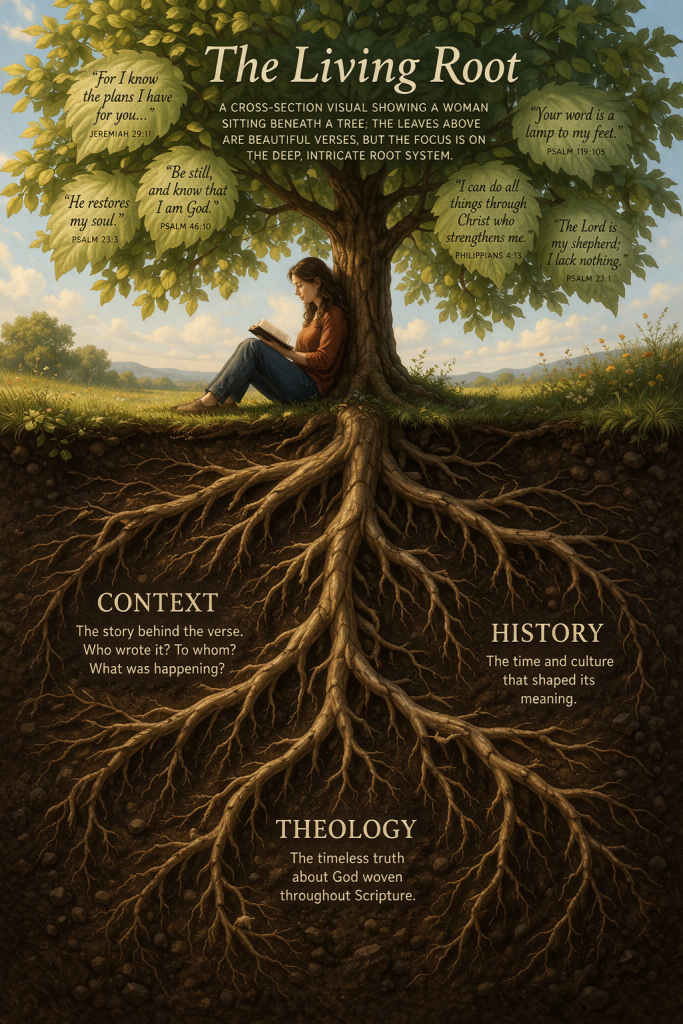
The “Splinternet” requires us to be of “full age,” capable of discerning the subtle lies embedded in our newsfeeds. One of the primary dangers of the current era is the weaponization of Scripture through proof-texting. In a world where anyone can clip a verse to support a political agenda or a self-help philosophy, the woman who does not know the whole Bible is at the mercy of the one who knows how to manipulate a single part of it. Misinformation thrives in the gaps of our knowledge. When we only know the “promises” without understanding the “covenants,” or when we claim the “blessings” without recognizing the “commandments,” we create a distorted view of God that cannot withstand the pressures of a secularized society. We must return to the practice of the Bereans, who were commended for their diligent examination of the scriptures to verify the teachings they received.
“These were more fair-minded than those in Thessalonica, in that they received the word with all readiness, and searched the Scriptures daily to find out whether these things were so.” (Acts 17:11)
They did not take the apostle’s word at face value; they checked the Source. The architecture of the Bible is a cohesive narrative that spans thousands of years, multiple authors, and various genres, yet it points to a singular redemptive arc centered on Jesus Christ. Skimming the surface of this narrative is like looking at the facade of a cathedral without ever stepping inside to see the structural beams that hold it together. To survive the Splinternet, we need to understand the structural beams of our faith. We need to know why the Old Testament is the foundation for the New and how the prophecies of old find their “Yes” and “Amen” in the Savior. Paul’s instruction to Timothy remains our primary mandate in this regard, emphasizing the need for precision and diligence in our study.
“Be diligent to present yourself approved to God, a worker who does not need to be ashamed, rightly dividing the word of truth.” (2 Timothy 2:15)
The phrase “rightly dividing” suggests a precise, surgical handling of the text that “skimming” simply cannot achieve. In our women’s ministries, we must move away from the “pink-washed” curriculum that treats women as if they are incapable of rigorous theological study. The hunger for substance is a sign of spiritual health. Women are increasingly asking for tools to understand hermeneutics, church history, and systematic theology because they realize that a “verse-of-the-day” will not help them explain the problem of evil to a grieving neighbor or defend the sanctity of life in a hostile workplace. They need the “whole counsel of God.” This shift requires a discipline that is counter-cultural to the digital age. It requires us to put down the phone and pick up the Book, to trade the scroll for the study, and to value the quiet work of meditation over the loud clamor of social media validation.
“Your word is a lamp to my feet and a light to my path.” (Psalm 119:105)
A lamp only illuminates the immediate step, but a light on the path provides a sense of direction for the journey ahead. To implement this practically, we must view our Bible study as a form of intellectual and spiritual infrastructure. Just as a city requires a robust grid to function during a storm, our minds require a robust biblical framework to function during a crisis of truth. This means reading through entire books of the Bible rather than jumping from chapter to chapter. It means using resources like commentaries, maps, and concordances to bridge the gap between our modern world and the ancient text. It also means acknowledging that some parts of the Bible are difficult to understand and require hard work to unpack. However, the reward for this labor is a faith that is unshakeable. When the Splinternet attempts to redefine morality or objective truth, the woman of the Word stands firm because she knows the character of the One who wrote the Story.
The misinformation age often relies on emotional manipulation to gain a foothold. By contrast, the Word provides a standard that equips us for every challenge and every good work.
“All Scripture is given by inspiration of God, and is profitable for doctrine, for reproof, for correction, for instruction in righteousness, that the man of God may be complete, thoroughly equipped for every good work.” (2 Timothy 3:16-17)
Notice that the goal is to be “complete” and “thoroughly equipped.” A devotional snippet may offer a moment of peace, but it rarely equips a person for the “good work” of navigating a complex, fractured world. Completeness comes from the totality of the Word. It comes from grappling with the “thou shalts” and the “thou shalt nots” as much as the “God loves you.” Furthermore, we must recognize that the “Splinternet” isn’t just about external misinformation; it’s about internal fragmentation. We are often tempted to compartmentalize our faith, keeping it separate from our professional lives, our parenting, and our digital interactions. Biblical literacy prevents this fragmentation by providing a unified worldview. It allows us to see every aspect of our lives through the lens of God’s sovereignty. When we are literate in the Scriptures, we don’t just find verses that apply to our lives; we find that our lives are a part of God’s larger story.
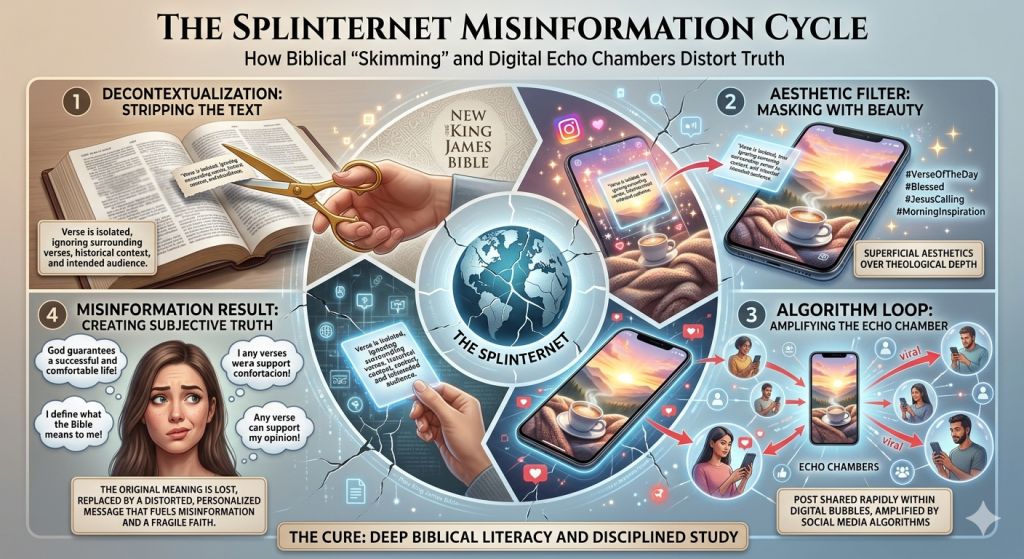
As we look toward the future of women’s ministry, let us be the leaders who call women into the depths. Let us be the ones who facilitate deep-dive studies into the Minor Prophets, the Epistles, and the Pentateuch. Let us celebrate the woman who asks the hard questions and the woman who stays up late studying the nuances of the Greek text. There is no greater defense against the deceptions of the Splinternet than a woman who is deeply rooted in the unchanging, authoritative, and breathed-out Word of God. The time for skimming is over. The time for substance has arrived. Let us be diligent, let us be disciplined, and let us be devoted not just to a feeling, but to the Truth that sets us free.