
Every Christmas, we return to the familiar story of a baby born in Bethlehem, angels announcing good news, and shepherds making their way to a humble manger. We decorate our homes, gather with family, and celebrate the greatest gift ever given to humanity: Jesus Christ, our Savior. Yet, tucked within the beautiful account of His arrival are the stories of three women whose faith, courage, and devotion deserve our attention. Their experiences remind us that the Christmas story is not simply about an extraordinary event that happened long ago. It is also about the faithfulness of God and the ordinary lives He chose to involve in His extraordinary plan.
Mary, Elizabeth, and Anna were women living in very different circumstances. Mary was a young woman whose future changed unexpectedly when an angel announced that she would give birth to the promised Messiah. Elizabeth was an older woman who had endured years of childlessness before experiencing God’s miraculous intervention. Anna was an elderly widow who had devoted much of her life to worship, prayer, and waiting for the redemption of Israel. Their journeys were different, their responsibilities were different, and their experiences of waiting upon God were certainly not identical. Yet Scripture brings their stories together around one glorious truth: God was fulfilling His promise through the coming of Jesus Christ.
As women today, we understand something about unexpected changes, unanswered prayers, and seasons of life that unfold differently from what we imagined. We know what it means to carry responsibilities while quietly wondering whether God sees our circumstances. We understand the longing for reassurance when the future is uncertain and the desire to know that our lives still have meaning when circumstances change.
This Christmas, I want to invite you to look more closely at these three women. Not because they offer a perfect formula for living, but because their lives reveal something important about faith, hope, spiritual influence, and the faithfulness of God.
The Christmas Story Was Always About God’s Faithfulness
Before examining the lives of Mary, Elizabeth, and Anna individually, we need to understand the larger story in which they participated. The birth of Jesus was not an isolated miracle that suddenly appeared without preparation. Throughout the Old Testament, God had revealed His promise of redemption, and generations of His people had waited for the coming Messiah. The prophets spoke of a coming deliverer, yet the fulfillment of those promises did not occur according to human expectations or schedules.
By the time we reach the opening chapters of Luke’s Gospel, God is bringing His long-promised plan into fulfillment. What is remarkable is that we witness this unfolding purpose through ordinary households, personal conversations, unexpected pregnancies, and faithful people who were waiting upon Him. God’s work was not confined to kings, priests, or those occupying positions of public power. Women were given meaningful roles within this remarkable period of biblical history.
Scripture Reflection — Galatians 4:4–5 (KJV)
“But when the fulness of the time was come, God sent forth his Son, made of a woman, made under the law, To redeem them that were under the law, that we might receive the adoption of sons.”
God’s timing was not accidental. The coming of Christ occurred according to His redemptive purpose, even though the people participating in those events could not yet understand everything that would follow.
Mary: Trusting God When the Future Is Uncertain
Faith Begins When We Take God at His Word
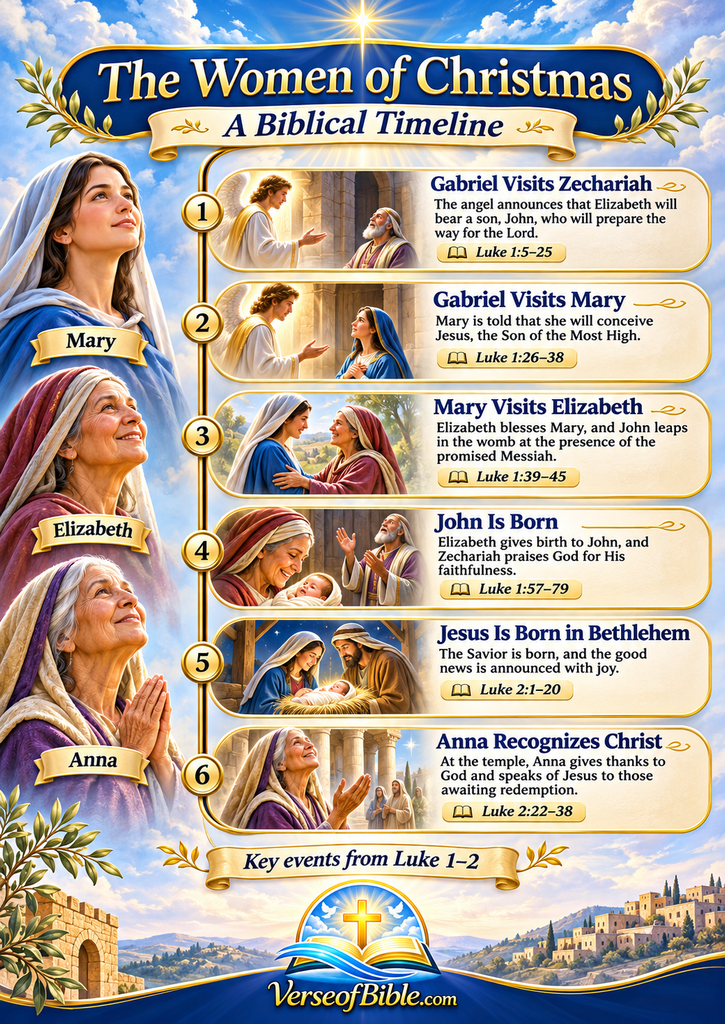
Mary’s story begins with an announcement that would change everything she thought she knew about her future. Luke 1:26–38 tells us that the angel Gabriel was sent to Nazareth, where he appeared to Mary and announced that she would conceive and give birth to a son named Jesus. She was betrothed to Joseph, and although Scripture does not provide a detailed account of her personal plans, we can understand that this announcement introduced responsibilities and circumstances she had not anticipated.
I believe we sometimes read Mary’s story too quickly because we already know how Christmas unfolds. We see the manger, the shepherds, and the beautiful nativity scenes, but Mary did not have the advantage of knowing the complete story. She was given an extraordinary promise without being told every difficulty she would encounter. She did not know the full extent of the responsibility she would carry or the sorrow she would one day experience as the mother of Jesus.
Mary asked Gabriel how these things would happen, and the angel explained that the Holy Spirit would come upon her. Her question reminds us that genuine faith does not require the absence of uncertainty. There is a difference between rejecting God’s Word and seeking to understand what He has revealed. Mary’s response demonstrates her willingness to trust the Lord even when the future remained largely unknown.
Scripture Reflection — Luke 1:38 (KJV)
“And Mary said, Behold the handmaid of the Lord; be it unto me according to thy word.”
Mary’s response was an expression of willing obedience. She accepted what God had declared, even though she could not see every step that lay ahead.
Consider how closely this connects with the lives of women today. Perhaps you are facing a difficult family decision, a change in employment, the responsibility of caring for an aging parent, or an unexpected turn in your marriage or household. Perhaps the life you imagined is unfolding in a completely different direction. You pray for wisdom, but the answers are not always immediate, and the road ahead may still appear uncertain.
Mary’s example reminds us that we do not need to possess complete knowledge of tomorrow before we can trust the God who holds tomorrow. We can make faithful decisions according to His Word while acknowledging that some questions remain unanswered. Trust is not pretending that everything is easy. It is choosing to remain faithful when we cannot see the complete picture.
Mary Teaches Us the Importance of Spiritual Reflection
Later, after Jesus was born and the shepherds shared what the angels had proclaimed, Luke tells us that Mary kept these things and pondered them in her heart. I find this detail particularly meaningful because it reveals another dimension of her faith. Mary did not simply experience extraordinary events and move on without thought. She considered what she had heard and witnessed.
Scripture Reflection — Luke 2:19 (KJV)
“But Mary kept all these things, and pondered them in her heart.”
There is an important lesson here for women living in a culture that demands immediate decisions, constant activity, and instant answers. Sometimes spiritual maturity requires us to slow down, reflect upon Scripture, pray, and consider what God has already revealed.
This Christmas, perhaps we need a little less pressure to make everything perfect and a little more willingness to create room for God’s Word. Mary’s experience reminds us that the quiet work of reflection matters just as much as the visible work of service.
Elizabeth: Finding Hope After a Long Season of Waiting
Faithfulness Does Not Mean Life Will Be Free of Disappointment
Elizabeth’s story speaks to a different kind of uncertainty. In Luke 1:5–25, we meet Elizabeth and her husband, Zechariah, both of whom are described as righteous before God. Yet their household carried a painful disappointment: they had no children, and they were both advanced in years.
This is a detail we should not overlook. Scripture identifies Elizabeth and Zechariah as faithful people while also acknowledging their unfulfilled desire. Their circumstances were not presented as evidence that they lacked faith or that God had rejected them. They were devoted to the Lord, and yet something deeply important to them remained unresolved.
How many women today can identify with that experience? We pray for our children, our marriages, our health, our families, and our future. We seek to live faithfully, but sometimes the circumstances we hoped would change remain exactly as they are. We watch other people experience blessings we have prayed for, and we may quietly wonder whether God has forgotten us.
Elizabeth’s story reminds us that outward circumstances do not provide a complete measure of someone’s relationship with God.
When the angel appeared to Zechariah, he announced that Elizabeth would bear a son, John, who would prepare the way for the Lord. What had seemed impossible in their circumstances became part of God’s extraordinary preparation for the coming Messiah.
Scripture Reflection — Luke 1:13 (KJV)
“But the angel said unto him, Fear not, Zacharias: for thy prayer is heard; and thy wife Elisabeth shall bear thee a son, and thou shalt call his name John.”
Elizabeth’s experience beautifully demonstrates God’s power and faithfulness, but we must also understand its proper biblical context. Her miraculous pregnancy was part of a specific moment in God’s redemptive plan. It should not be interpreted as a guarantee that every woman will eventually receive the exact earthly outcome for which she has prayed.
There are prayers whose answers may not come in the way we expect. There are circumstances that may remain difficult despite years of faithful service. Yet our confidence in God must be grounded in His character rather than in the assumption that His timing will always match our desires.
Elizabeth teaches us that seasons of waiting do not make our lives meaningless, nor do they diminish the value of our faithfulness.
Elizabeth Shows Us the Ministry of Encouragement
One of the most beautiful moments in the Christmas account occurs when Mary visits Elizabeth. Luke 1:39–45 describes their meeting, including Elizabeth’s Spirit-filled recognition of the significance of Mary’s child.
Consider what this encounter reveals about the relationship between these women. Elizabeth had experienced an extraordinary blessing of her own, yet she did not turn Mary’s arrival into an opportunity to compare their experiences. Instead, she recognized God’s work in Mary’s life and spoke words of blessing over her.
Scripture Reflection — Luke 1:45 (KJV)
“And blessed is she that believed: for there shall be a performance of those things which were told her from the Lord.”
Elizabeth’s response illustrates the spiritual influence women can have upon one another. Rather than allowing comparison to diminish their relationship, Elizabeth used her words to strengthen and affirm Mary.
I believe this is especially relevant to Christian women today. We live in a culture where comparison can quietly influence our understanding of success, worth, and spiritual significance. We compare families, marriages, careers, ministries, homes, and personal accomplishments. Yet Elizabeth reminds us that another woman’s calling or blessing does not diminish our own place within God’s purposes.
We need women who are willing to encourage rather than compete. Women who will celebrate another person’s spiritual growth, offer wisdom when life becomes uncertain, and speak the truth of God’s Word when someone needs reassurance.
Anna: Remaining Faithful When Life Has Changed
Your Spiritual Influence Does Not Have an Expiration Date
Anna’s story appears in Luke 2:36–38, when Mary and Joseph bring the infant Jesus to the temple in Jerusalem. Although this encounter takes place after Jesus’ birth, it belongs to the larger biblical account of His arrival and the recognition of God’s promised salvation.
Luke identifies Anna as a prophetess, the daughter of Phanuel, from the tribe of Asher. We are also told that she had been married for seven years before becoming a widow and that she was of great age. The details of her earlier years are limited, but Scripture clearly describes a woman whose life was characterized by devotion to God through fasting, prayer, and worship.
What strikes me about Anna is that Scripture does not present her later years as a period of spiritual insignificance. She had experienced the loss of her husband, and her life circumstances were different from those she had known during marriage. Yet she continued serving God.
For women today, Anna’s example offers a particularly important message. Some women reach a stage in life where they wonder whether their most meaningful contributions are behind them. Their children have grown, their careers have changed, or their health and responsibilities look different from earlier years. Others have experienced widowhood or a major personal loss that has altered their sense of identity and purpose.
Anna reminds us that our relationship with God and our capacity for spiritual influence are not limited to one stage of life.
Scripture Reflection — Luke 2:36–37 (KJV)
“And there was one Anna, a prophetess, the daughter of Phanuel, of the tribe of Aser: she was of a great age…”
The passage continues by describing Anna’s faithful worship and service to God through prayer and fasting.
Anna’s life challenges the assumption that our value decreases when our circumstances change. Her devotion was meaningful, and Scripture preserves her testimony as part of the account of Christ’s coming.
A Faithful Woman Recognizes the Redeemer
When Anna encountered Jesus at the temple, she gave thanks to God and spoke about Him to those who were waiting for the redemption of Jerusalem. Her worship became testimony, and her recognition of Christ became an opportunity to share the good news.
Scripture Reflection — Luke 2:38 (KJV)
“And she coming in that instant gave thanks likewise unto the Lord, and spake of him to all them that looked for redemption in Jerusalem.”
Anna’s response teaches us that a faithful life does not need to be publicly celebrated to have significance. She was not introduced as a queen, political leader, or wealthy benefactor. She was a prophetess whose devotion to God prepared her to recognize and proclaim the arrival of the Redeemer.
There are women in our churches today whose spiritual influence may never receive public recognition. They faithfully pray, encourage younger believers, teach Scripture, serve their communities, and share their testimony. Their contribution may appear ordinary to the world, but it can have a lasting impact upon the people whose lives they touch.
Anna reminds us that no season of life is spiritually insignificant when it is lived in devotion to God.

Three Women, Three Different Journeys, One Faithful God
When we examine the lives of Mary, Elizabeth, and Anna together, we begin to see the richness of their individual stories. Mary demonstrates trust in God’s Word when the future is uncertain. Elizabeth demonstrates faithfulness through disappointment and the importance of encouraging others. Anna demonstrates the lasting significance of prayer, devotion, and testimony.
These women did not share the same circumstances, and they were not called to fulfill identical responsibilities. One was preparing for motherhood, another experienced motherhood after years of longing, and the third was a widow whose life was devoted to spiritual service. Yet all three became witnesses to the fulfillment of God’s promises through Jesus Christ.
This is something we must remember when considering the lives of Christian women today. God does not require every woman to follow the same earthly path. Marriage, motherhood, professional responsibility, ministry, singleness, widowhood, and later life all bring different opportunities and challenges. Our value before God cannot be measured simply by our marital status, age, accomplishments, or visibility.
The greater lesson is that faithfulness can be expressed through different responsibilities and seasons. We do not need to become someone else before our lives can reflect God’s goodness. We are called to respond faithfully to Him within the circumstances and responsibilities entrusted to us.
| Woman | Expression of Faith | Key Scripture | Lesson for Today |
|---|---|---|---|
| Mary | Trust and obedience amid uncertainty | Luke 1:26–38 | Trust God even when the future is unclear. |
| Elizabeth | Faithfulness in waiting and encouragement | Luke 1:5–45 | Remain faithful and strengthen other women. |
| Anna | Prayer, worship, and testimony | Luke 2:36–38 | Spiritual influence continues throughout life. |
What Do Mary, Elizabeth, and Anna Teach Christian Women This Christmas?
As we approach Christmas, I encourage you to consider which of these women speaks most closely to your present circumstances. Perhaps you identify with Mary because your future feels uncertain. You are facing responsibilities you never anticipated, and you are seeking the courage to follow God’s Word without knowing exactly how everything will unfold.
Perhaps Elizabeth’s story speaks to you because you have experienced a long season of waiting. There are prayers you continue to bring before the Lord, and you are learning to remain faithful without allowing disappointment to define your relationship with Him.
Or perhaps Anna’s experience is particularly meaningful because your life has changed. You may be entering retirement, adjusting to widowhood, learning to live with an empty nest, or wondering how God might continue to use your gifts and experience.
Wherever you find yourself this Christmas, remember that the central message of these three women’s stories is not that every difficulty will disappear or that every earthly desire will be fulfilled. Their stories direct us toward the faithfulness of God and the coming of Jesus Christ.
Scripture Reflection — Luke 2:11 (KJV)
“For unto you is born this day in the city of David a Saviour, which is Christ the Lord.”
Christmas is ultimately not about the perfection of our circumstances. It is about the arrival of our Savior and the fulfillment of God’s promise of redemption.
Mary trusted the announcement of His coming. Elizabeth rejoiced in the unfolding fulfillment of God’s promise. Anna recognized and proclaimed the Redeemer. Each woman’s story points beyond herself to Jesus Christ.
A Christmas Prayer for Women of Faith
Heavenly Father, thank You for the gift of Your Son, Jesus Christ, and for the examples of faithfulness You have preserved in Your Word. As we reflect upon the lives of Mary, Elizabeth, and Anna, help us to trust You when our future is uncertain, remain faithful through seasons of waiting, and recognize the opportunities You give us to serve and encourage others.
When we feel discouraged, remind us of Your promises. When we are tempted to compare our lives with those around us, help us remember that our worth is found in You. Teach us to use our words to strengthen others, our time to grow in Your presence, and our lives to reflect the hope of the Gospel.
May this Christmas season draw our hearts closer to Jesus Christ and deepen our desire to walk faithfully with You.
In Jesus’ name, Amen.
Conclusion: The Lasting Message of the Women of Christmas
The stories of Mary, Elizabeth, and Anna remind us that God’s purposes unfold through women of different ages, experiences, and circumstances. Their influence was not measured by worldly recognition, personal achievement, or the appearance of a perfect life. It was revealed through their faithful responses to the work of God.
This Christmas, may we learn from Mary’s trust, Elizabeth’s encouragement, and Anna’s devotion. May we recognize that our circumstances do not determine our worth, that our words can strengthen another woman’s faith, and that our spiritual influence does not diminish simply because our season of life has changed.
Above all, may we remember the One at the center of their stories: Jesus Christ, our Savior, the fulfillment of God’s promise, and the true source of our Christmas hope.